

CureSureMedico
|
EN

Carotid Artery Surgery

Vascular Surgery

payments

Starting from

$4,000

Up to $15,000 depending on centre

schedule

Typical duration

7–12 days

Including pre-operative work-up

arrow_downwardlocal_hospital

Partner hospitals

2

Vetted for outcome data & accreditation

Dr. Rodina Ainasoa

Content reviewed for medical accuracy by: Dr. Rodina Ainasoa · Medical Content Writer & Health Communications

Overview

Surgical and endovascular treatment of carotid artery stenosis to prevent stroke, including carotid endarterectomy (CEA) and carotid artery stenting (CAS), performed by experienced vascular and neurovascular teams. India, Turkey, and Israel provide accredited centers with proven outcomes for international patients at significantly reduced cost.

Your case is matched to a centre on the basis of clinical outcome data, not marketing. We coordinate every step — from pre-operative work-up to post-treatment follow-up — with a dedicated care coordinator.

What's included

Vascular neurology consultation and carotid Doppler/CT angiography review
CEA or CAS procedure by specialist vascular or neurovascular surgeon
Intraoperative neurological monitoring
Hospital stay (typically overnight, 1–2 nights) with neurological observation
Post-operative duplex ultrasound before discharge
Coordinator support, interpreter, and remote follow-up consultation

Carotid Artery Surgery

Coordinated from

$4,000

or message us on WhatsApp

No commitment required. Your data is never shared with third parties.

Carotid Endarterectomy (CEA) vs. Carotid Artery Stenting (CAS)

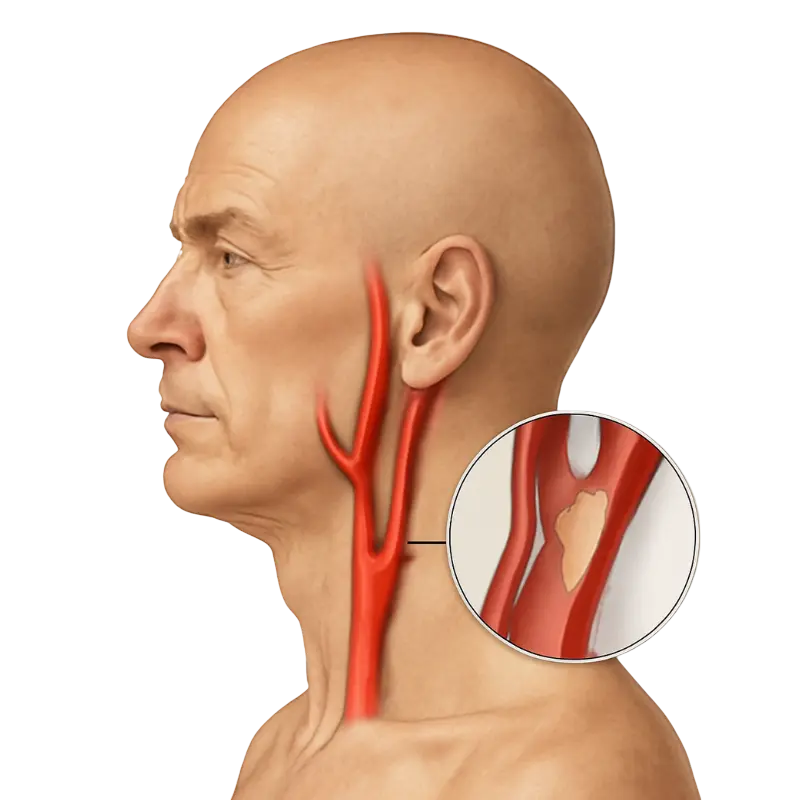
Significant narrowing of the carotid artery can be treated by open surgical removal of the plaque (CEA) or by a catheter-based stent (CAS). Candidacy for either approach — and whether surgery is needed at all — is determined by a vascular surgeon and neurologist based on your degree of stenosis, symptom status, and overall cardiovascular risk, not by self-assessment.

ParameterEndarterectomy (CEA)Stenting (CAS)
What it isAn open surgery in which a neck incision is made, the artery is opened, and plaque is physically removed before the artery is closed, often with a patch, per Cleveland Clinic.A catheter-based procedure in which a permanent metal mesh stent is threaded to the narrowed section of the artery, typically via the leg, arm, or neck, and expanded to hold it open, per Cleveland Clinic.
Invasiveness & hospital stayAn open procedure typically lasting 1–2 hours; most patients stay one night in hospital and are discharged the following day, per Cleveland Clinic and Mayo Clinic-aligned sources.A minimally invasive procedure typically lasting 1–2 hours; patients are usually admitted for the day and kept overnight for observation, per Cleveland Clinic.
Periprocedural stroke & heart attack riskIn the CREST trial, CEA carried a lower periprocedural stroke rate (2.3%) but a higher heart attack rate (2.3%) than CAS.In the CREST trial, CAS carried a higher periprocedural stroke rate (4.1%) but a lower heart attack rate (1.1%) than CEA.
Effect of patient age on outcomesCREST trial data showed progressively better outcomes with CEA in patients older than 70.The same CREST trial data showed progressively better outcomes with CAS in patients younger than 70.
Longer-term artery re-narrowingRe-narrowing (restenosis) is less common after CEA than after stenting, reflecting direct surgical removal of the plaque.Restenosis after CAS occurs in an estimated 11–40% of cases, though significant re-narrowing requiring retreatment occurs in fewer than 5%, per Cleveland Clinic.

The Procedure: Step by Step (Carotid Endarterectomy)

The steps below outline the general carotid endarterectomy process, the most evidence-backed approach for most patients; your vascular surgeon and neurologist will confirm whether CEA or CAS is right for your anatomy and risk profile.

1

Anaesthesia and incision

You receive general or local anaesthesia, and the surgeon makes an incision of several inches in the neck at the site of the blockage, per Cleveland Clinic.

2

Temporary blood flow bypass

The surgeon assesses whether your brain needs additional blood flow support during the procedure and, if so, inserts a temporary shunt to maintain circulation while the artery is open, per Cleveland Clinic and Mayo Clinic-aligned sources.

3

Plaque removal and closure

The artery is opened, the plaque is carefully removed from inside it, and the artery is then closed with stitches, often reinforced with a patch to reduce future re-narrowing, per Cleveland Clinic.

4

Restoring blood flow and recovery room monitoring

Normal blood flow to the brain is restored and the incision is closed; you are then monitored closely in the recovery room, where your team checks for any new neurological symptoms, per Cleveland Clinic and Mayo Clinic-aligned sources.

Recovery Timeline

Recovery Timeline
Hospital stay

Most patients undergoing CEA stay overnight and are discharged the following day; CAS patients are typically also kept overnight for observation after the procedure, per Cleveland Clinic.

First 1–2 weeks

Normal activities generally resume within one to two weeks after CEA; after CAS, heavy lifting is avoided for the first week before activity is gradually increased, per Cleveland Clinic.

Weeks to months

Bruising and soreness at the incision or catheter site typically resolve within about a week; jaw or neck numbness after CEA, when present, can persist for six months to a year, per Cleveland Clinic.

Ongoing

Your vascular team will schedule follow-up duplex ultrasound imaging to monitor the treated artery for re-narrowing over time.

Source: Cleveland Clinic; CREST trial (Stroke, New England Journal of Medicine). Individual recovery varies and is guided by your surgical team.

Known Risks & Limitations

  • Periprocedural stroke occurred in 2.3% of CEA patients versus 4.1% of CAS patients in the CREST trial, a statistically significant difference.
  • Periprocedural heart attack occurred in 2.3% of CEA patients versus 1.1% of CAS patients in the CREST trial — the opposite pattern from stroke risk.
  • Cranial nerve injury (most often affecting the nerves controlling the tongue or voice box) is a CEA-specific risk, with persistent injury beyond hospital discharge occurring in an estimated 4% of cases; the large majority resolve within months and permanent deficits are rare.
  • General risks shared by both approaches include bleeding, infection, blood clots, and — because this is a procedure to prevent stroke in patients who may already have significant vascular disease — a baseline cardiovascular risk that your medical team will assess individually.
  • Restenosis (re-narrowing of the artery) is more common after CAS (11–40%) than after CEA, though only a minority of CAS restenosis cases require retreatment, per Cleveland Clinic.

Source: CREST trial (Stroke, New England Journal of Medicine); Cleveland Clinic. No procedure is without risk; your vascular surgeon and neurologist will review your individual risk factors, including age, before recommending an approach.

The CureSureMedico Care Pathway

Remote clinical review

Share your carotid Doppler ultrasound or CT/MR angiography results and neurology notes. Our coordination team forwards your case to a vascular surgeon and neurologist to confirm your degree of stenosis, symptom status, and whether CEA or CAS is the appropriate approach.

Urgency and travel-safety check

Because timing matters for stroke prevention, your case is reviewed for urgency before any travel is arranged — patients who have recently had a TIA or stroke with significant stenosis are not recommended for international travel until they have stabilized.

Surgical capacity matching

Your partner centre confirms vascular surgical theatre and neurological monitoring capacity, and stent availability if CAS is recommended, before your estimate is finalised.

Consolidated estimate

A cost estimate covering the procedure, intraoperative neurological monitoring, hospital stay, and pre-discharge duplex ultrasound is issued before you travel, based on the recommended approach.

Recovery and follow-up handover

Your care team monitors your overnight recovery and completes pre-discharge imaging before you are cleared to travel home. A treatment summary and a recommended follow-up ultrasound schedule are shared with your home vascular specialist so monitoring for artery re-narrowing continues after you return.

Global cost comparison — Carotid Artery Surgery

Average coordinated costs across our partner centres. Final pricing depends on clinical complexity and chosen hospital.

CountryAvg. costvs. cheapest
🇮🇳

India

New Delhi · Chennai · Bengaluru · Hyderabad · Mumbai · Kochi

Best value✓ Verified
$5,000
chevron_right
🇹🇷

Turkey

Istanbul

Estimate
$9,000
chevron_right

Costs are indicative estimates and vary by procedure specifics, hospital, and clinical complexity. Request a personalised estimate for your specific case.

Cost & recovery by procedure

This treatment category covers several different operations with different levels of invasiveness, recovery times, and costs. The country averages above blend all of them together — use the breakdown below for a more realistic, procedure-specific estimate.

Carotid Endarterectomy (CEA)

The surgeon makes an incision along the neck and physically removes the fatty plaque built up inside the carotid artery, restoring normal blood flow to the brain and reducing stroke risk. It is the most evidence-backed procedure for carotid stenosis and remains the preferred option for most patients, particularly those over 70.

Typical recovery · 2–4 weeks

Hospital stay is typically overnight to 2 nights with neurological monitoring before discharge; most patients resume light activity within a week and are fully recovered within 2–4 weeks, avoiding heavy lifting or straining in the meantime. In the landmark CREST trial, periprocedural stroke occurred in 2.3% of CEA patients; watch for wound swelling, difficulty swallowing, or any new weakness, numbness, or speech changes, which need immediate medical attention.

India

$2,800–$6,000

Turkey

$6,000–$9,500

Thailand

$9,000–$14,000

Carotid Artery Stenting (CAS)

A catheter is threaded through a small puncture in the groin (or increasingly the neck, in TCAR) up to the narrowed carotid artery, where a balloon expands a mesh stent to hold the vessel open, with a filter device used to catch any debris. It is preferred for patients with high surgical risk, prior neck radiation or surgery, or anatomy that makes open surgery difficult.

Typical recovery · 1–2 weeks

Usually performed with an overnight hospital stay; most patients return to light activity within a few days and normal activity within 1–2 weeks, faster than the open surgical approach. In the CREST trial, periprocedural stroke occurred in 4.1% of CAS patients versus 2.3% for CEA, while heart attack was less common with stenting; dual antiplatelet medication is required for several weeks afterward, and any new neurological symptoms should be reported immediately.

India

$4,000–$7,500

Turkey

$5,000–$9,000

Thailand

Estimate pending verification — ask your care coordinator for a current quote

Cost ranges are indicative estimates for international patients and vary with implant choice, number of levels treated, surgeon, and hospital. Request a personalised quote for your specific case.

Clinical detail: AAOS OrthoInfo, Mayo Clinic Health System, Cleveland Clinic. Cost ranges cross-checked across multiple independent medical-tourism sources per country where marked; ranges flagged "pending verification" could not be independently confirmed at the time of writing.

Partner hospitals

2 centres
View all hospitals
Amrita Hospital

Amrita Hospital

Faridabad, India

Asia's largest private hospital — 2,600 beds, 64 operation theatres, 81 specialties on a 130-acre campus in Delhi NCR. NABH & NABL accredited. Centres of excellence in oncology, cardiac surgery, BMT, organ transplantation, neurosciences, and IVF.

NABHNABL

800+

Specialists

2,600+

Beds

View Profile
Indraprastha Apollo Hospital

Indraprastha Apollo Hospital

New Delhi, India

Indraprastha Apollo Hospital in Sarita Vihar, New Delhi is one of India's foremost multi-specialty tertiary care centres, part of the Apollo Hospitals network established by Dr. Prathap C Reddy in 1983. The 710-bed facility records 1,600+ daily OPD visits, 1,000+ international patient consultations monthly, and receives 5,000+ international patients per year from over 120 countries. Its Centres of Excellence span cardiac sciences, oncology, neurosciences, organ transplantation, nephrology, orthopaedics, gastroenterology, and bariatric surgery. The hospital is equipped with Da Vinci XI robotic systems, CyberKnife radiosurgery, 3 Tesla MRI, LINAC, ECMO, and a 3D neuro-navigation system.

JCINABHNABL

700+

Specialists

710+

Beds

View Profile

Frequently asked questions

Urgency depends on your symptoms and degree of stenosis. If you have recently had a TIA (mini-stroke) or stroke with significant stenosis (70–99%), guidelines recommend surgery within 2 weeks, which generally does not allow for international travel planning. However, for asymptomatic stenosis discovered incidentally (typically 70–80% or greater) or for patients whose symptoms have stabilized, elective planning over 4 to 8 weeks is safe and appropriate. Your case will be reviewed by our vascular specialist before any travel is arranged; we will not recommend international travel for any patient where urgency makes it unsafe.

No fees. No commitment.

Our guidance is completely free

We are compensated by our partner hospitals — never by patients. You get independent clinical matching, cost transparency, and end-to-end coordination at no cost to you.

Message us on WhatsApp