
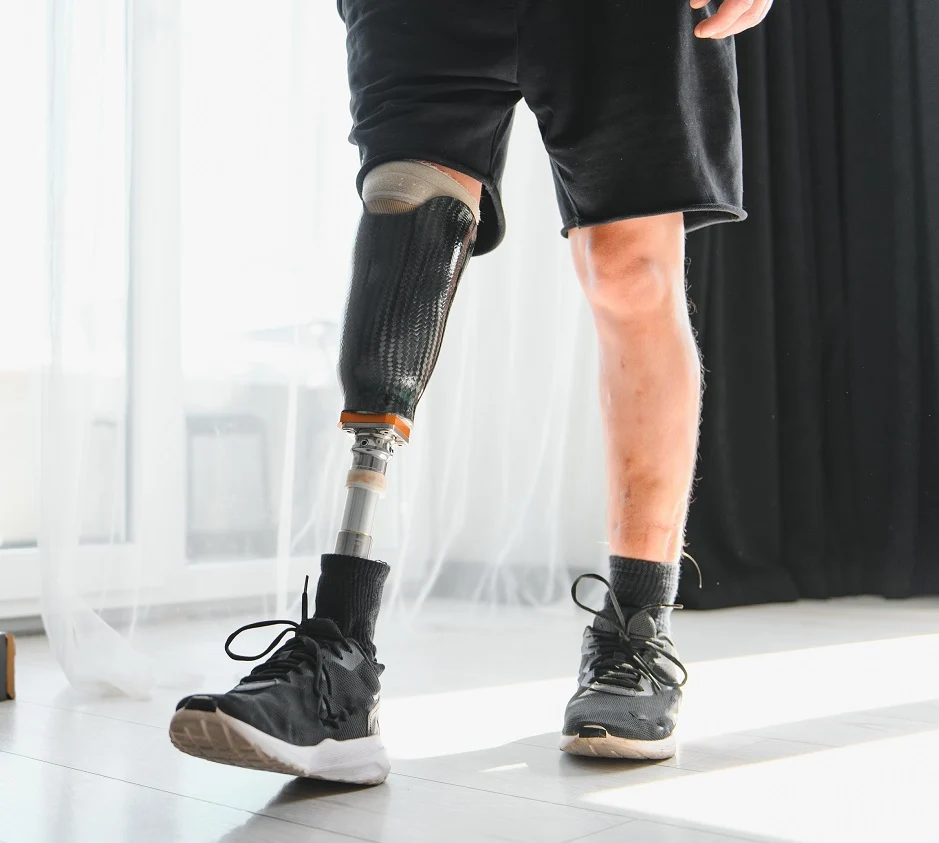
Above-Knee & Below-Knee Limb Prosthetics
Rehabilitation
Starting from
$4,000
Up to $28,000 depending on centre
Typical duration
5–14 days
Including pre-operative work-up
Content reviewed for medical accuracy by: Dr. Rodina Ainasoa · Medical Content Writer & Health Communications
Overview
Access certified prosthetists at internationally accredited rehabilitation centres abroad for high-quality prosthetic limbs — transtibial and transfemoral — at a fraction of Western prices. Patients benefit from expert fitting, gait training, and comprehensive follow-up care in leading medical tourism destinations.
Your case is matched to a centre on the basis of clinical outcome data, not marketing. We coordinate every step — from pre-operative work-up to post-treatment follow-up — with a dedicated care coordinator.
What's included
Above-Knee & Below-Knee Limb Prosthetics
Coordinated from
or message us on WhatsApp
No commitment required. Your data is never shared with third parties.
Below-Knee (Transtibial) vs. Above-Knee (Transfemoral) Prosthesis
The level of amputation is the single biggest factor shaping how a prosthesis is fitted, how it is used, and how much energy walking with it takes. Here is how below-knee and above-knee fittings compare.
| Parameter | Below-Knee (Transtibial) | Above-Knee (Transfemoral) |
|---|---|---|
| Joints replaced by the device | Only the ankle-foot complex is replaced; the patient's own knee joint is retained. | Both the knee and ankle-foot complex are replaced by prosthetic components, which the patient must learn to control. |
| Socket and suspension | A below-knee socket bears weight over the residual shin and knee area, typically with a liner and pin, suction, or sleeve suspension. | An above-knee socket must capture and stabilise a shorter residual thigh, often needing more precise contouring and, in some cases, additional suspension such as a hip belt. |
| Extra walking energy required | Walking typically requires roughly 10-40% more energy than walking with two natural legs, per rehabilitation literature. | Walking typically requires substantially more energy — commonly cited at roughly 50-70% or more above baseline — reflecting the added demand of controlling a prosthetic knee. |
| Typical rehabilitation training focus | Gait training focuses mainly on the ankle-foot roll-over and weight-bearing through the socket. | Gait training additionally covers learning to control prosthetic knee stability and swing, which generally takes longer to master. |
| Typical functional outcomes | Most patients achieve good functional mobility, including a return to most daily activities, per the Amputee Coalition. | Most patients achieve good functional mobility, though outcomes vary more with residual limb length, muscle strength, and overall health. |
The Fitting Process: Step by Step
The steps below outline a typical prosthetic-limb fitting process. Your prosthetist will confirm the exact plan based on your amputation level, residual limb condition, and mobility goals.
Residual limb assessment and measurement
A certified prosthetist examines the residual limb's shape, skin condition, muscle strength, and range of motion, and takes detailed measurements to guide device design.
Socket casting and fabrication
A cast or digital scan of the residual limb is taken to fabricate a custom-fitted socket, matched to a suitable foot, ankle, and, for above-knee fittings, knee component.
Initial fitting and alignment
The prosthetist fits a trial socket, checking pressure distribution, comfort, and joint alignment, and makes adjustments before the definitive device is finalised.
Gait and functional training
Physiotherapy sessions teach the patient to walk safely and efficiently with the new prosthesis, progressing from parallel bars to unassisted walking on varied surfaces as confidence and skill improve.
Fitting & Adaptation Timeline
Initial socket fitting and alignment sessions take place, with short wear periods to check skin tolerance before wear time is gradually increased, per the American Academy of Orthotists and Prosthetists.
Gait training progresses from parallel bars and assistive devices toward independent walking, with adjustments made as swelling in the residual limb continues to settle.
Most patients build stamina and confidence for daily activities, though above-knee users typically need more time to master prosthetic knee control than below-knee users.
Residual limb volume continues to change for months to years after amputation, so periodic socket adjustments, liner changes, or a replacement socket are a normal, expected part of long-term prosthetic use.
Source: American Academy of Orthotists and Prosthetists; Amputee Coalition; Mayo Clinic; Cleveland Clinic. Individual timelines vary and are guided by your treating prosthetist.
Known Risks & Limitations
- Socket fit changes over time as residual limb volume fluctuates from swelling, muscle changes, or weight change, so periodic adjustments, new liners, or socket replacement are typically needed and should be expected, not treated as a failure of the original fitting.
- Skin irritation, pressure sores, or blistering can develop if socket fit is not right or wear time increases too quickly, making regular skin checks and prompt reporting of soreness important.
- Functional outcomes vary considerably by amputation level, residual limb length, muscle strength, and overall health, so results achieved by one patient do not guarantee the same result for another.
- Prosthetic components wear over time and require ongoing maintenance, servicing, and eventual replacement, which patients should budget and plan for beyond the initial fitting.
- Proper gait training and correct walking technique matter for long-term joint health, since compensatory movement patterns from a poorly fitted device or inadequate training can contribute to back, hip, or sound-limb joint strain over time.
Source: American Academy of Orthotists and Prosthetists; Amputee Coalition; Mayo Clinic; Cleveland Clinic. No device or fitting process is without limitations; your treating prosthetist will review your individual case.
The CureSureMedico Care Pathway
Remote case review
Share details of your amputation level, residual limb condition, and mobility goals with our coordination team, who forward your case for an initial suitability review.
Prosthetist and clinic matching
We match you with an internationally accredited rehabilitation centre and certified prosthetist experienced in fitting the specific device type — below-knee, above-knee, partial foot, or microprocessor knee — that suits your case.
Consolidated cost estimate and travel planning
Once your case is reviewed, we issue a cost estimate covering assessment, fabrication, fitting sessions, and gait training, and help plan a trip length matched to the typical 5-14 day fitting process.
Fitting, alignment, and functional training
During your stay, your device is cast, fabricated, and fitted across multiple appointments, and you complete gait and functional training with a physiotherapist before being cleared to travel home.
Follow-up and continuity of care
Before you depart, we share your fitting records and component details with a local prosthetist or your home-country care team so future socket adjustments and long-term maintenance can continue without interruption.
Global cost comparison — Above-Knee & Below-Knee Limb Prosthetics
Average coordinated costs across our partner centres. Final pricing depends on clinical complexity and chosen hospital.
| Country | Avg. cost | vs. cheapest |
|---|---|---|
🇮🇳 India New Delhi · Chennai · Bengaluru · Hyderabad · Mumbai · Kochi | $6,000 | —chevron_right |
🇹🇷 Turkey Istanbul | $18,000 | +200%chevron_right |
Costs are indicative estimates and vary by procedure specifics, hospital, and clinical complexity. Request a personalised estimate for your specific case.
Frequently asked questions
Most patients require 3–5 fitting appointments over the course of their stay to refine socket fit, alignment, and comfort. A trial prosthesis is used before the definitive device is delivered, ensuring the best possible functional outcome before you travel home.
No fees. No commitment.
Our guidance is completely free
We are compensated by our partner hospitals — never by patients. You get independent clinical matching, cost transparency, and end-to-end coordination at no cost to you.