
Regenerative Therapy for Orthopedic Conditions
Hematology
Starting from
$1,500
Up to $8,000 depending on centre
Typical duration
3–10 days
Including pre-operative work-up

Content reviewed for medical accuracy by: Dr. Rodina Ainasoa · Medical Content Writer & Health Communications
Overview
Access evidence-based regenerative treatments — including PRP injections and mesenchymal stem cell therapy — for joint degeneration, cartilage damage, and tendon injuries at internationally accredited centres. Patients benefit from cutting-edge biologics-based care at a fraction of Western costs, with shorter waiting times and personalised rehabilitation support.
Your case is matched to a centre on the basis of clinical outcome data, not marketing. We coordinate every step — from pre-operative work-up to post-treatment follow-up — with a dedicated care coordinator.
What's included
Regenerative Therapy for Orthopedic Conditions
Coordinated from
or message us on WhatsApp
No commitment required. Your data is never shared with third parties.
PRP Injection vs. Prolotherapy for Orthopedic Conditions
Platelet-rich plasma (PRP) injection and prolotherapy are the two most commonly used injection-based regenerative approaches for tendon, ligament, and joint conditions. Which one, if either, suits a given condition depends on the specific diagnosis and the published evidence for that indication — not a general assumption that either approach helps every condition, per the American Academy of Orthopaedic Surgeons (AAOS).
| Parameter | PRP Injection | Prolotherapy |
|---|---|---|
| What is injected | A concentrate prepared from the patient's own blood, containing platelets and growth factors, per Mayo Clinic and Cleveland Clinic. | An irritant solution, commonly dextrose, injected into and around a ligament or tendon attachment to stimulate a local healing response, per AAOS. |
| Typical number of sessions | Often one to three injections spaced several weeks apart, depending on the condition and clinic protocol. | Usually a series of three to six injections spaced two to six weeks apart, per published prolotherapy protocols. |
| Strength of evidence (knee osteoarthritis, as an example indication) | Systematic reviews and meta-analyses report clinically meaningful improvements in pain and function versus placebo at 3-12 months, with some evidence of superior functional improvement compared with hyaluronic acid — though preparation protocols vary widely across studies, per peer-reviewed literature. | Evidence for knee osteoarthritis is more limited than for PRP, with fewer high-quality randomized trials; some studies suggest benefit but findings are less consistent, per peer-reviewed literature. |
| Strength of evidence (lateral epicondylitis / tennis elbow, as an example indication) | Randomized trials report superior long-term pain relief and functional recovery compared with conservative management, though comparisons with other active treatments vary by study, per peer-reviewed literature. | Clinical trials show prolotherapy is an effective option but have not consistently shown it to be superior to physiotherapy or other active treatments for this condition, per peer-reviewed literature. |
| Regulatory status | PRP remains an off-label, investigational use in many jurisdictions and is not FDA-approved specifically for osteoarthritis, so it is often not covered by insurance, per AAOS. | Prolotherapy solutions are commonly available medications used off-label for this purpose; regulatory oversight of the injection technique itself varies by country, per AAOS. |
The Procedure: Step by Step
The steps below outline a typical course of PRP or prolotherapy injection treatment for an orthopedic condition. Your specialist will confirm which approach, if either, is supported by evidence for your specific diagnosis.
Diagnostic imaging and patient selection
The specialist reviews your history, examination findings, and imaging (such as ultrasound or MRI) to confirm the diagnosis and assess whether published evidence supports PRP or prolotherapy for your specific condition, per AAOS and Mayo Clinic.
Blood draw and PRP preparation (where PRP is used)
For PRP, a small sample of the patient's blood is drawn and processed in a centrifuge to concentrate the platelets and growth factors into an injectable preparation; prolotherapy instead uses a premixed irritant solution, so this step does not apply to that approach.
Image-guided injection
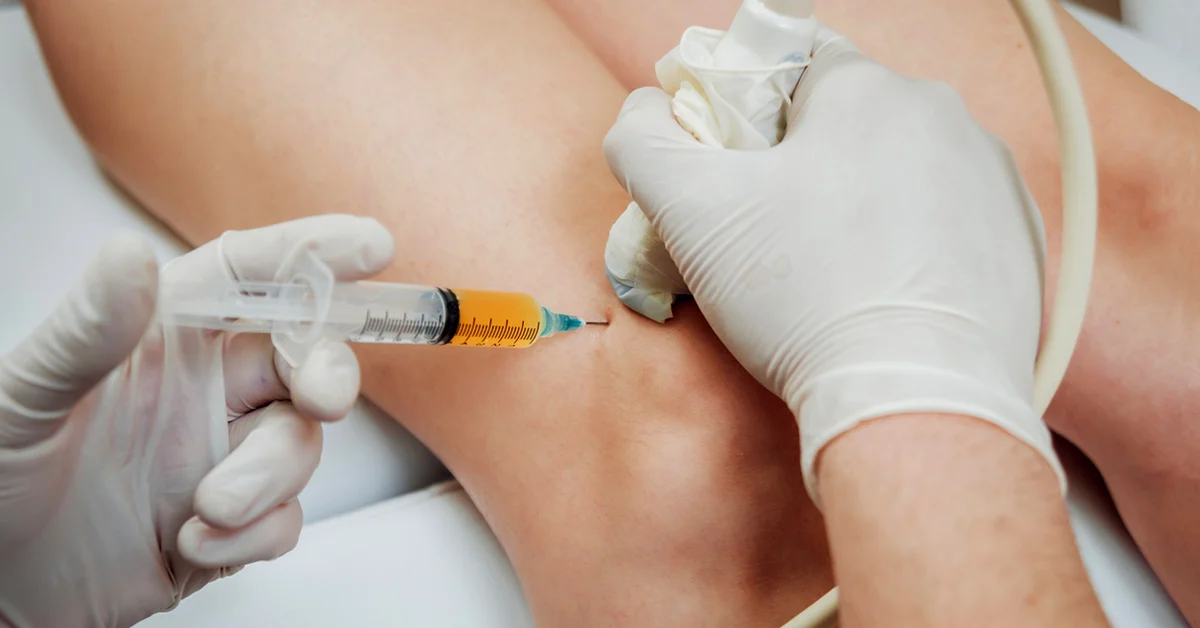
The prepared PRP or prolotherapy solution is injected into the target tendon, ligament, or joint, typically under ultrasound guidance to improve placement accuracy, per Cleveland Clinic.
Post-injection protocol and monitoring
Patients are monitored briefly after injection and given activity guidance for the following days; because a course of injections is often required, the specialist schedules follow-up sessions and reassesses response before repeating treatment.
Recovery Timeline
Temporary soreness, swelling, or stiffness at the injection site is common and typically resolves within a few days; this is a well-documented, expected reaction rather than a sign the treatment has failed, per AAOS and Mayo Clinic.
Any early improvement, if it occurs, tends to be gradual rather than immediate; most protocols involve additional injections during this period rather than a single one-time treatment.
Where a treatment response occurs, published studies report clinically meaningful improvements in pain and function becoming more apparent from this point through several months of follow-up; response is not guaranteed and varies by condition and individual, per peer-reviewed literature.
Longer-term outcomes continue to be studied and vary considerably between conditions and individuals; patients should discuss realistic, condition-specific expectations with their treating specialist rather than assuming a fixed recovery timeline, per AAOS.
Source: American Academy of Orthopaedic Surgeons (AAOS); Mayo Clinic; Cleveland Clinic; peer-reviewed systematic reviews and meta-analyses of PRP and prolotherapy. Individual recovery and results vary and are not guaranteed.
Known Risks & Limitations
- Evidence quality varies significantly by specific condition — some indications, such as knee osteoarthritis and certain tendinopathies, have a reasonable and growing body of supportive trial data, while for many other conditions marketed by clinics the evidence remains limited or inconsistent, per AAOS and peer-reviewed literature.
- Improvement is not guaranteed, and where it occurs it is typically gradual and incremental rather than curative; PRP and prolotherapy are not a substitute for surgery in cases where surgery is clinically indicated, per AAOS.
- Standard injection risks apply, including infection at the injection site, temporary pain flare-up, bruising, and the possibility of no meaningful improvement despite treatment, per Mayo Clinic and Cleveland Clinic.
- Because PRP preparation protocols (platelet concentration, leukocyte content, activation method) vary widely between clinics and are not standardized, results reported in one study or clinic may not directly translate to another, per peer-reviewed literature.
- Patients should seek treatment centers that are transparent about the published, condition-specific evidence and realistic expected outcomes for their exact diagnosis, rather than general claims that regenerative injections can regenerate or repair any joint or tissue problem, per AAOS patient guidance.
Source: American Academy of Orthopaedic Surgeons (AAOS); Mayo Clinic; Cleveland Clinic; peer-reviewed systematic reviews and meta-analyses. No procedure is without risk, and evidence for this treatment category varies significantly by condition; your treating specialist will review your individual case.
The CureSureMedico Care Pathway
Remote clinical review
Share your diagnosis, imaging, and prior treatment history with our coordination team, who forward your case for an initial specialist assessment of whether published evidence supports PRP or prolotherapy for your specific condition.
Evidence-based clinic matching
We match you with an accredited orthopedic center experienced in your specific condition and injection technique, verified against the published evidence base rather than general marketing claims.
Cost estimate and session planning
We issue a consolidated cost estimate covering consultation, imaging review, and the expected course of injections, and help plan a trip length that accounts for whether multiple sessions are likely to be needed.
Treatment and monitoring
You attend your injection session(s) under image guidance, with post-injection monitoring and activity guidance provided by your care team throughout your stay.
Follow-up and continuity of care
Before you depart, your treatment records and a realistic follow-up timeline are shared with your home-country physician so they can monitor your response and coordinate any further sessions if needed.
Global cost comparison — Regenerative Therapy for Orthopedic Conditions
Average coordinated costs across our partner centres. Final pricing depends on clinical complexity and chosen hospital.
| Country | Avg. cost | vs. cheapest |
|---|---|---|
🇮🇳 India New Delhi · Chennai · Bengaluru · Hyderabad · Mumbai · Kochi | $2,000 | —chevron_right |
🇹🇷 Turkey Istanbul | $4,000 | +100%chevron_right |
Costs are indicative estimates and vary by procedure specifics, hospital, and clinical complexity. Request a personalised estimate for your specific case.
Frequently asked questions
Most patients require 1–3 injection sessions depending on the severity of joint damage. PRP typically shows gradual improvement over 4–12 weeks as the platelet growth factors stimulate tissue repair. Mesenchymal stem cell therapy may produce earlier functional gains, with many patients reporting reduced pain and improved mobility within 6–8 weeks. Your orthopaedic specialist will recommend the optimal protocol after reviewing your imaging and clinical history.
No fees. No commitment.
Our guidance is completely free
We are compensated by our partner hospitals — never by patients. You get independent clinical matching, cost transparency, and end-to-end coordination at no cost to you.